


Wide band gap (WBG) perovskite solar cells are a key element for all perovskite tandem solar cells, multi-junction space PV, and transparent PV technological applications. WBG perovskites with band gaps ~1.8 eV are particularly promising as top absorbers with a narrow band gap ~1.2 eV in all perovskite tandem Solar Cells architectures, enabling optimal spectral utilization and unlocking pathways to exceed the Shockley–Queisser efficiency limit of single-junction devices. Certified efficiencies of all-perovskite tandem solar cells have surpassed 31%, with a reported record of 31.38% efficiency.
To achieve the band gap ~1.8 eV, FA/Cs-based perovskites with compositions Cs0.17FA0.83Pb(I0.6Br0.4)3 are widely employed. This requires incorporating a high Br fraction, which strongly affects the crystallization process and hinders the control of film morphology and optoelectronic quality. In Br-rich perovskites, variations of only a few seconds in processing parameters lead to pronounced changes in semiconductor quality and device performance.
Early antisolvent dripping (5 s after spin initiation) yields flat films with microcracks, whereas delayed dripping (10 s) results in a wrinkled morphology. Comprehensive structural, optical, and electrical analyses reveal that wrinkled films exhibit enhanced crystallinity, reduced defect activation energy, and suppressed nonradiative recombination. Temperature-dependent photoluminescence shows lower activation energies for wrinkled films, indicating improved carrier transport. Importantly, scanning photocurrent microscopy provides direct spatial evidence of morphology-controlled lateral charge transport, demonstrating significantly longer electron and hole transport lengths in wrinkled films compared to flat counterparts.
Further enhancement is achieved through interfacial passivation, which extends lateral transport lengths and reduces interfacial recombination losses. As a result, wrinkled and passivated devices achieve power conversion efficiencies up to 18.54% with reduced voltage losses. These findings establish a direct correlation between morphology, interfacial quality, and charge transport in WBG perovskites, highlighting morphology engineering as a powerful strategy for advancing all perovskite tandem solar cells.
Reference: Details of this work have been published in Jana, S.; Singha, A.; Singh, M. K.; Nayak, S.; Laxmi, L.; Bhardwaj, B.; Balasubramaniam, K. R.; Kabra, D., “Correlation of Morphology and Interface Properties with Charge Transport in Wide Band Gap Perovskite Solar Cells,” ACS Energy Lett. 2025, 11 (1), p. 799.
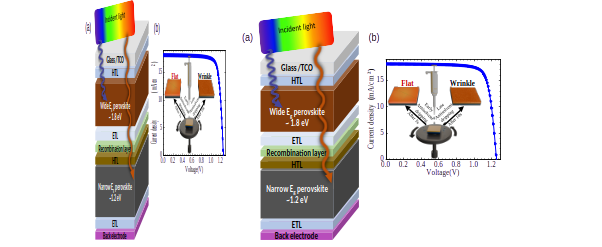
(Left) Schematic diagram of 2T All-Perovskite Tandem Solar Cell (Right) Current density (J) - Voltage (V) characteristics under simulated AM1.5G illumination.