



Researchers at NCPRE, IIT Bombay, have developed a novel DC-DC converter topology for medium-voltage DC applications aimed at improving the efficiency, power density, and scalability of grid-connected photovoltaic and MVDC power conversion systems. The research proposes a Capacitive Isolated Series Stacked Dual Active Bridge (CISS- DAB) converter topology that combines capacitive isolation with a series-stacked converter structure to achieve high voltage gain without requiring high turns-ratio transformers or multiple transformer windings. In a conventional medium-voltage DC-DC converter, transformer insulation requirements and high turns ratios significantly increase system size and complexity. The proposed topology addresses these challenges by using capacitors to block medium-voltage DC stress, while the series-stacked structure multiplies the output voltage. This reduces insulation stress on the medium-frequency transformer, decreases magnetic component size, and reduces the number of active switches, resulting in improved efficiency and higher power density. The proposed topology is validated using a 4 kW hardware prototype. Experimental results demonstrated efficiencies up to 98.4%, and reduced component count compared to conventional input-parallel output-series Dual Active Bridge converters. The topology also demonstrates scalability to higher voltage levels, making it suitable for medium-voltage photovoltaic inverters, solid-state transformers, and emerging MVDC distribution systems. This work carried out by Jenson Joseph Attukadavil and Prof. B. G. Fernandes was presented at the 2025 IEEE Energy Conversion Conference Congress and Exposition (ECCE), Philadelphia, PA, USA.
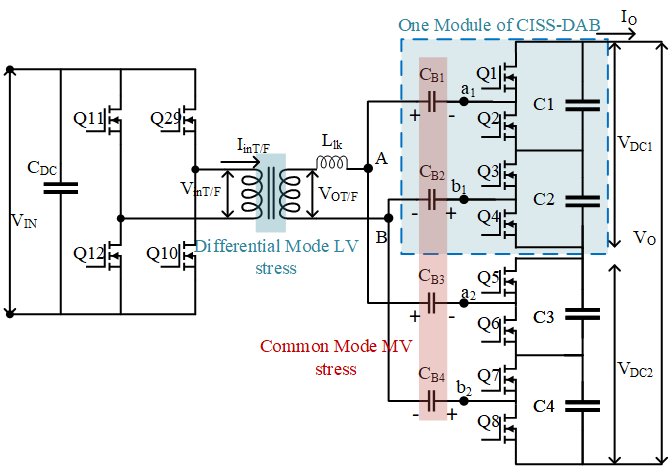
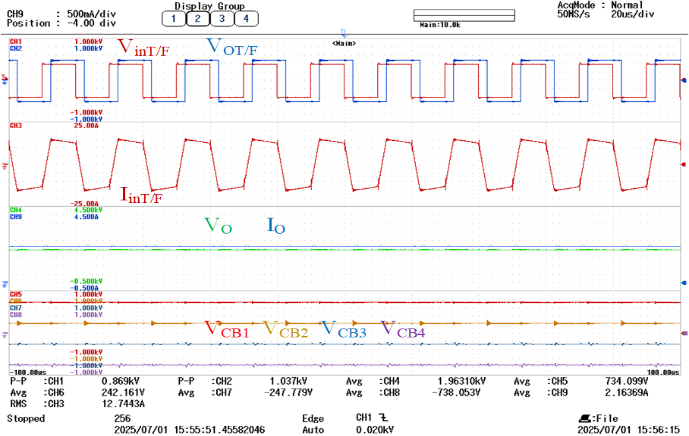
(Top) Proposed CISS-DAB converter topology. (Bottom) Experimental waveforms for CISS-DAB with output 1968 V at 4 kW from a 400 V input.